What Is Competitive Intelligence? A Founder's Guide
Summary
What is competitive intelligence? It is the ongoing, legal and ethical process of collecting and analyzing information about rivals and the wider market, then turning it into decisions. It differs from market research, which studies demand, and from competitor analysis, which is a one-time snapshot. For small teams it runs as a four-step cycle: define the question, collect public evidence, find the pattern, and deliver a one-page brief.
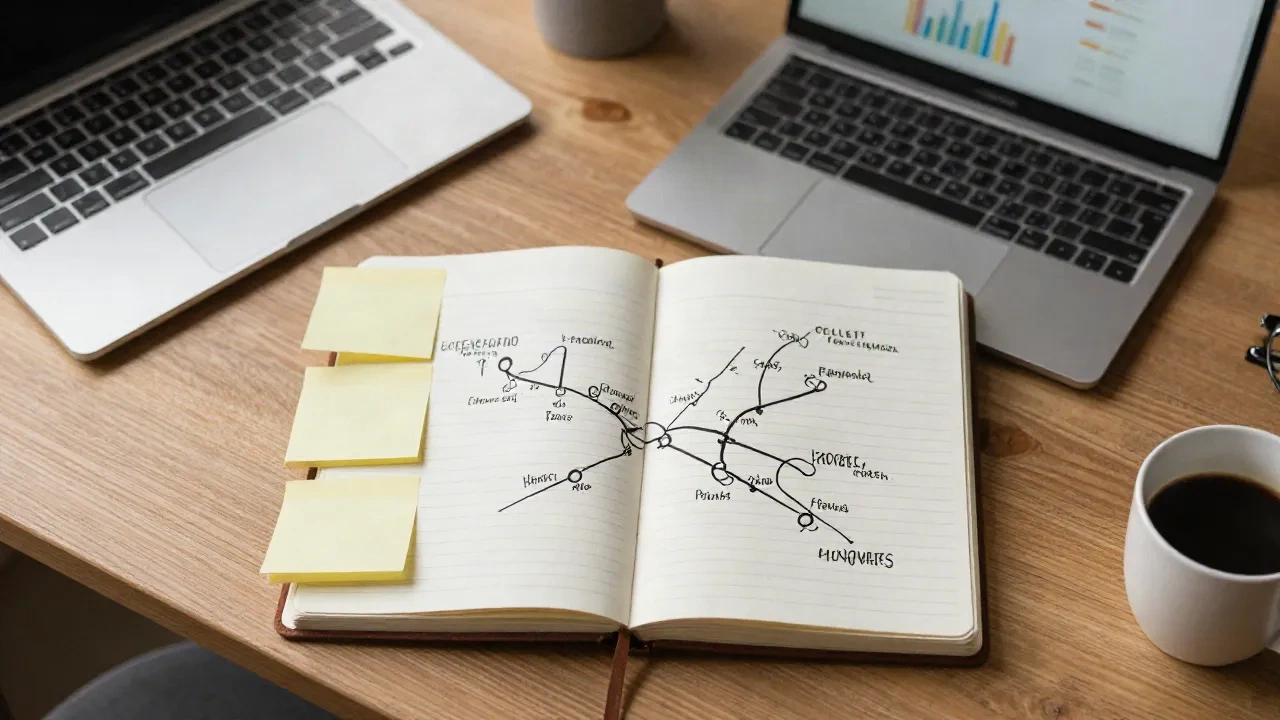
What is competitive intelligence? It is the habit of collecting and analyzing information about rivals, buyers and the wider market, then turning it into a decision someone can act on this week. The key word is decision. A folder of competitor screenshots is not intelligence. A one-page note that says "we should stop competing on price against this player" is.
Most early founders think they already do this because they glanced at three competitor websites before building. That is a start. It is not a system, and the gap between the two is where a lot of eighteen-month detours begin.
Why does the definition keep shifting?
Ask five practitioners and you get five answers. One trade-secrets white paper even notes that the term has no consistently accepted definition. Two ideas show up everywhere, though. Competitive intelligence is a process, not a document. And it ends in a recommendation, not a report.
The Society of Competitive Intelligence Professionals (SCIP), founded in 1986, frames it as the legal and ethical collection and analysis of information about competitors' capabilities, vulnerabilities and intentions. That last word matters. Knowing what a rival sells today is trivia. Knowing what they are likely to do next quarter is intelligence.
On paper, it holds up. In the field, let's see what snags: the definition works, but only if someone owns the question "so what do we do about it?" In a four-person company, that someone is you.
Competitive intelligence, competitor analysis and market research: what is the difference?
These three terms get swapped constantly, and swapping them leads to the wrong homework. Here is the cleanest split.
Market research looks at customers, demand and market size. It answers "is there a market, and who is in it?"
Competitor analysis is a snapshot. It describes a rival's product, pricing and positioning, usually at one point in time.
Competitive intelligence is the ongoing layer on top. It tracks change, interprets motives and feeds decisions.
Competitive intelligence tools are only the delivery mechanism. They are not the discipline.
Wikipedia's overview adds a useful nuance: CI covers the entire business environment and its stakeholders, not just the companies you consider rivals. For a founder, that means suppliers, regulators, adjacent products and even your customers' do-it-yourself workarounds belong in scope. You can read the Wikipedia entry on competitive intelligence for the academic framing.
Skip the temptation to treat market research as a substitute. Market research tells you demand exists. It will not tell you that two funded teams shipped the same feature last month.
What are the main types of competitive intelligence?
The most common split is by time horizon, and it is the one worth remembering.
Strategic intelligence looks ahead. It informs which market to enter, which segment to ignore and where a rival is heading. Think of a quarterly question: "Is the incumbent moving down-market, and does that open space above them or squeeze us?"
Tactical intelligence is short-term and operational. Which objections come up in sales calls against a specific rival? What did they change on their pricing page on Tuesday? This is the material that helps a salesperson, or you, win this month's deal.
Some sources add a third axis, continuous versus ad hoc. Continuous means a light, regular rhythm: a weekly scan, a shared note, an alert. Ad hoc means a one-off sprint before a launch or a pricing change. A solo founder usually needs both, in very small doses.
How does the intelligence cycle work in practice?
Practitioners describe CI as a cycle rather than a checklist, and SCIP-style models share a common backbone. Formal versions add a fifth step for feedback, but the logic is the same. Reduced to what a small team can actually run, it has four steps.

1. Planning: define the question. Not "learn about competitors," but "why are trial users choosing the other tool?" A sharp question cuts the research time by half. Ask three questions before writing a single line of code, and the same applies here: who decides, what decision, and by when.
2. Collection: gather from sources you can defend. Public sources do most of the work. Pricing pages, changelogs, job postings, review sites, public filings, customer interviews, sales-call notes. A hiring spree for enterprise sales engineers tells you more about strategy than a press release does.
3. Analysis: find the pattern, not the fact. A fact is "they raised their price." A pattern is "they raised their price while removing the free tier, which suggests they are chasing larger accounts and leaving a gap below."
4. Dissemination: deliver it where decisions happen. A one-page brief in the place your team already works. If nobody reads it, nobody acts on it, and the cycle failed at the last step.
Most founders do step two with enthusiasm, skip step one, and never get to step four. That is why their folder of screenshots grows and their decisions do not change.
Where do founders go wrong with competitive intelligence?
The first error is collecting without a question. The second is treating a competitor's feature list as the whole picture. Features are easy to copy; positioning, distribution and pricing logic are not.
The third error is subtler: confusing activity with signal. A competitor redesigning their homepage is activity. A competitor changing who the homepage speaks to is signal. Learn to tell them apart and you will save yourself hours of anxiety.
A fourth, uncomfortable one: reading rivals so closely that you copy their roadmap. Competitive intelligence should help you choose where not to compete. If your plan after a month of research is "do the same, slightly cheaper," go back to step one.
It is not a mistake, it is a data point. A rival ignoring a segment you assumed was obvious is not a sign you missed something. It may be the most useful finding in the whole exercise.
A worked example. Take a founder building a scheduling tool for outdoor guide companies. The obvious rivals are general booking apps. A week of collection shows that most of them charge per seat, review sites are full of complaints about seasonal pricing, and none mention permits or equipment. That is a pattern, not a fact. The decision that follows is concrete: price per season rather than per seat, and build permit tracking before anything else.
Nothing in that example needed a paid platform. It needed a question, a handful of public sources and the willingness to write down a conclusion. Notice also what the analysis ruled out: a feature race against general booking apps. Knowing what to leave alone is half the value.
What does a lightweight setup look like for a small team?
You do not need a platform to start. You need a rhythm and a place to write things down. A workable first month looks like this.
Week 1: list five to eight alternatives, including the non-obvious ones (spreadsheets, agencies, doing nothing).
Week 2: read each one's pricing page, changelog and ten recent customer reviews. Note what customers praise and what they complain about.
Week 3: talk to three to five people who chose a competitor over you, or over the category. Ask what they were trying to get done.
Week 4: write the one-page brief. Three findings, one risk, one decision.

After the first month, move to a thirty-minute weekly check. Set a couple of alerts, scan the changelogs, add to the same note. That is a continuous process, and it costs less than a monthly coffee budget in most cases.
Which competitive intelligence tools are worth knowing?
Tools are worth it when the manual version has become the bottleneck, not before. The categories are straightforward.
Dedicated competitive intelligence platforms such as Crayon and Klue track competitor changes and package them into battlecards for sales teams. They make sense once a sales team exists and keeps asking the same questions. For a solo founder they are usually too much.
Web and traffic analytics tools estimate where competitor visitors come from and how large their audience is. They are useful for sizing a rival's distribution, with the caveat that their numbers are estimates and skew for smaller sites.
Audience research tools answer a different question: where your target customers already spend attention, which podcasts they follow, who they trust. That is competitive intelligence about attention, and it is often more actionable than a feature table.
Worth the money if a sales or growth team will use the output weekly. Skip if you are still deciding whether the idea deserves a build. For that stage, a notebook and ten customer conversations beat any dashboard.
Is it legal? Yes, when you stick to public and consented sources. SCIP's own definition stresses legal and ethical collection, and that is a good rule: no pretending to be a customer to extract confidential material, no scraping behind a login you are not entitled to, no recruiting a rival's employee to ask about their roadmap. Public pricing, filings, job postings, reviews and your own customer conversations give you more than enough.
What would we actually do first?
Pick one decision you have to make in the next thirty days: a price, a segment, a launch angle. Write the single question behind it. Spend a week collecting only what answers that question. Then write three sentences and act.
The real risk is not failure, it is spending 18 months on the wrong thing. Competitive intelligence will not remove that risk, but it will shrink it, because it forces you to look outward before you build. Here is what no score can measure: whether you will actually change your plan when the evidence says so. Which decision on your desk would look different if you knew what your three closest alternatives were doing next quarter?