Paper Trading: The Validation Sprint Most Traders Skip
Summary
Paper trading means practicing buy and sell orders with fake money on live market data, free through Schwab, Webull, and Interactive Brokers. It's a real test of mechanics: chart reading, position sizing, rule-following. What it can't test is discipline once real money is at risk, which is why a strong paper trading record rarely predicts live performance. Treat it as a mechanics check, not proof you're ready.
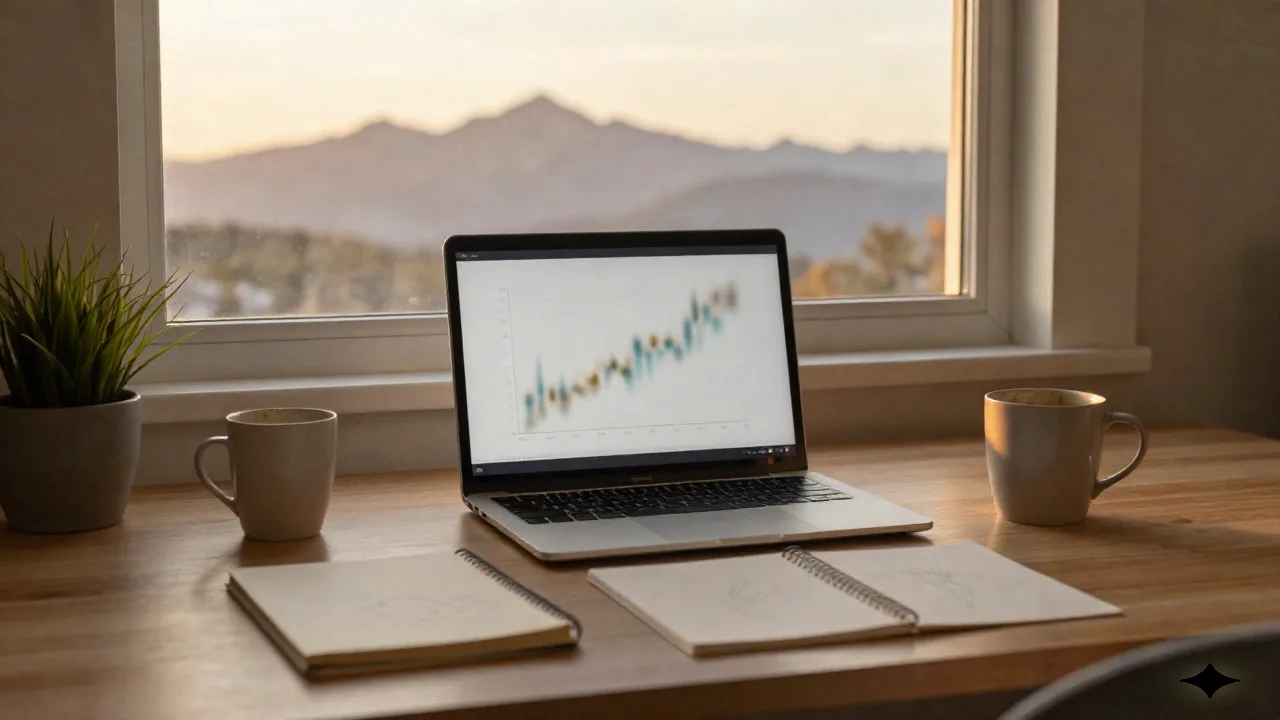
Paper trading means placing simulated buy and sell orders with fake money on live market data, so you can test a strategy before a single real dollar is at risk. Every major broker gives it away free: Schwab's thinkorswim, Webull, Interactive Brokers, Moomoo. The mechanics take an afternoon to learn. What almost no guide tells you is that paper trading is a hypothesis test, and like every hypothesis test worth running, it only tells you the truth if you're honest about what it can measure and what it can't.
What Paper Trading Actually Tests (and What It Doesn't)
A paper trading account mirrors a real one closely. You get a starting balance (Schwab hands you $100,000, Interactive Brokers starts you near $1 million), live prices, real order types, and a portfolio that updates the way a funded one would. You can test a moving-average crossover, an earnings-day options play, or a plain buy-and-hold rule against actual market behavior with zero financial exposure.
Here is what it measures well: whether you understand the mechanics. Can you read a chart, size a position, place a stop order, and follow your own rules for five trades in a row without improvising? That is a real, testable skill, and paper trading is a legitimate way to build it.
Here is what it cannot measure: whether you will follow those same rules once the money is real. That gap is the entire subject of this article, and it is the reason a clean paper trading track record predicts almost nothing about live performance.
Why Paper Trading Is a Validation Sprint, Not a Rehearsal
We spend most of our time here telling founders the same thing: test the hypothesis before you spend the runway. Don't build the full product on a guess about what customers want. Run the smallest experiment that could prove you wrong, and pay attention to what it actually shows you instead of what you hoped it would.
Paper trading is that same discipline, aimed at a market instead of a customer segment. The strategy is the hypothesis. The simulated trades are the experiment. The account balance is the scorecard. It holds up on the page. The real question, the one most traders skip, is whether it still holds up once the numbers are real and the account is yours.
Three things a paper trading log can validate cleanly:
Whether the rules are even followable. If you break your own stop-loss rule in a simulator where nothing is at stake, that is data, not a fluke.
Whether the strategy has a statistical edge at all. Fifty simulated trades with a negative expectancy will not turn positive once real money enters. If it loses on paper, it loses.
Whether you understand the instrument. Options assignment, margin calls, and short-selling mechanics are easier to learn without a margin call actually happening to you.
What it cannot validate is discipline under pressure, and pretending otherwise is the single most common mistake we see people bring from paper accounts into funded ones.
The 97% Problem: What the Data Actually Says
Most paper trading guides quietly skip the outcome data, probably because it is not encouraging. A widely cited academic study tracked every individual who started day trading Brazilian equity futures between 2013 and 2015, one of the largest futures markets in the world. Among traders who persisted for more than 300 days, 97% lost money, and fewer than 1% earned more than a bank teller's starting salary. The researchers found no evidence that traders improved with experience. The ones who kept going simply kept losing, at roughly the same rate, year after year.
That number is not an argument against paper trading. It is an argument against treating a clean simulator record as proof of anything. If persistent, experienced traders show no measurable learning curve in live markets, a few weeks of stress-free simulated wins should not be read as evidence you have cracked something they haven't.
The founders we talk to make a parallel mistake constantly: a positive signal in a small, low-stakes test (a survey, a landing page, a handful of friendly beta users) gets treated as proof the whole idea works. It is not proof. It is one data point that removes one specific risk. Paper trading removes exactly one risk too: whether the strategy has positive expectancy under ideal execution. It removes nothing else.

If you are running this as an actual experiment and not just clicking buttons, keep the log somewhere structured. A simple table works: date, thesis, entry, exit, what you expected to happen, what actually happened. Most people who paper trade for a month can't tell you their win rate from memory. That alone should tell you something about how seriously the exercise is usually taken.
How Long Should You Paper Trade Before Going Live?
Nobody gives you a real number for this, and that is worth noticing. Brokers who host free paper trading accounts have no incentive to tell you when to stop, since a live account is the product they are actually selling.
A more useful frame borrows directly from hypothesis testing: you stop paper trading not after a fixed number of weeks, but after you hit one of three outcomes.
The strategy loses consistently across at least 30 to 50 trades. Kill it. No amount of real-money discipline fixes a negative-expectancy system.
The strategy wins, but only because of unrealistic fills. This happens more than people admit, and it's the subject of the next section. Fix the assumptions and retest before risking anything.
The strategy wins under realistic assumptions, and you can articulate exactly why it works. If you can't explain the edge in one sentence, you have found a pattern in noise, not a strategy. Go back and test more before funding an account.
Thirty to fifty trades is a rough floor, not a target. A strategy that only trades weekly could take the better part of a year to hit that sample size, and rushing it defeats the point.
Where the Simulation Quietly Breaks
This is the part every honest comparison of paper trading vs. real trading eventually gets to, and it's worth being specific about the mechanics instead of waving at "emotions."
Paper trades fill instantly, at the exact price on your screen. Real markets do not work that way. During normal conditions the gap is small. During the exact moments that matter most (earnings surprises, flash moves, low-liquidity names) you get slippage, partial fills, and spreads that widen right when you need to get out. A strategy that looks profitable on perfect simulated fills can break even or lose money once realistic execution is priced in, and that gap alone accounts for a meaningful share of the "it worked on paper" disappointment.
Then there is the part that has nothing to do with execution quality. Losing $400 of pretend money produces a flicker of annoyance. Losing $400 you actually have produces a physiological response: the same fight-or-flight chemistry that made humans bad at rational decisions under threat for a very long time before anyone invented a brokerage account. That response pushes people to exit winners too early, hold losers too long hoping to break even, and abandon a tested plan mid-trade because staying in feels unbearable. None of that shows up in a simulator, because a simulator has nothing to threaten.

We see the founder version of this constantly. Someone runs a flawless validation process, gets encouraging signals from ten customer interviews, and then freezes the first time a real client asks for a real invoice. The interviews were the paper account. The invoice is the live one. Skip if you're looking for a shortcut around that moment: there isn't one. The only way to find out how you behave with real stakes is to eventually have some.
AI Tools That Make the Research Half Less Painful
Paper trading still requires research: reading filings, tracking earnings dates, understanding why a stock moved before you decide whether your thesis was right or just lucky. A handful of AI tools have gotten genuinely useful for that layer, without replacing the judgment call itself.
For actually parsing a company's numbers instead of skimming a headline, an AI-native research platform can save real hours: pulling filings, summarizing earnings calls, and flagging what changed quarter over quarter instead of leaving you to reconstruct it by hand.
For fast, sourced answers to "why did this move today" or "what's the analyst consensus on this sector," a research-focused AI browser beats scrolling five open tabs of half-relevant news, and it forces you to see the sources instead of taking a headline's word for it.
For stress-testing a thesis before you enter a trade, walking a general-purpose model through your reasoning and asking it to argue the other side is a cheap way to catch the assumption you didn't notice you were making. Treat the output as a second opinion, never as the decision.
None of these tools close the gap between paper and real. They just make sure the hours you spend paper trading are spent on the research, not on assembling it manually.

So Should You Keep Paper Trading, or Go Live?
If your strategy has not cleared 30 to 50 trades with a real, explainable edge, stay on paper. There is no upside to funding an account early, and the data on persistent losers suggests the market will not teach you anything paper trading hasn't already shown you.
If it has cleared that bar, the honest move is to go live with an amount small enough that losing all of it would sting but not derail you, specifically to find out how you behave once it's real. That number, not another month of simulated wins, is the actual test you've been avoiding.